

Why is the Queen’s Guide Award not named the King’s Guide Award?
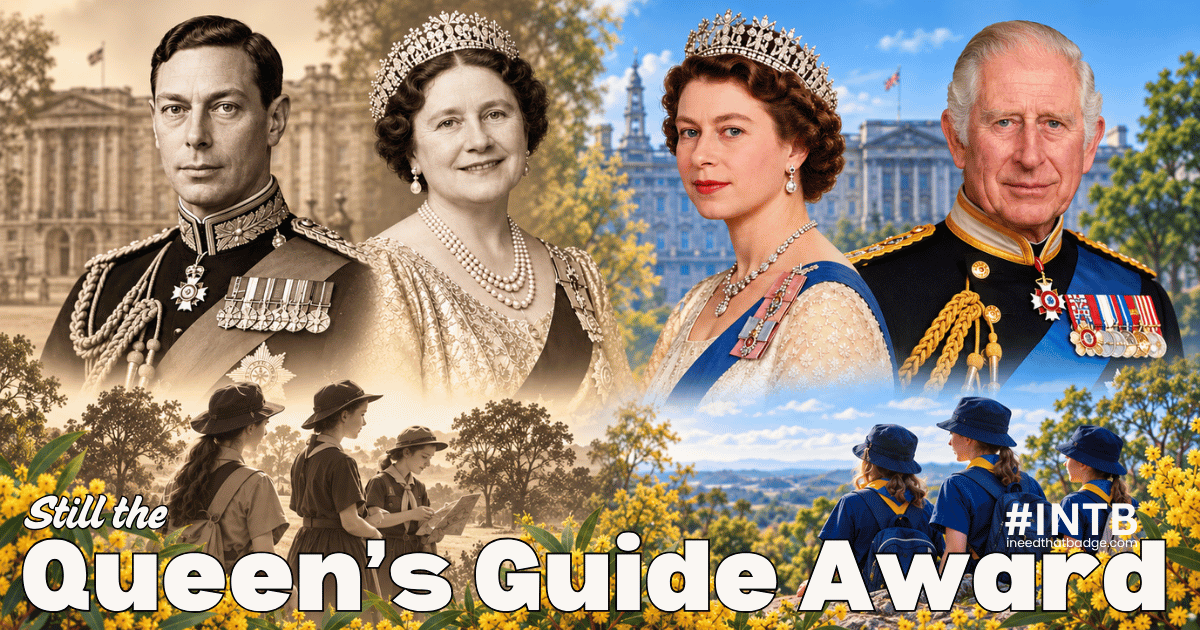
Why is the peak award called the Queen’s Guide Award when we have a King?
As Australia now has a King, shouldn’t the highest Guiding award be referred to as the King’s Guide Award?
Not at all.
It sounds logical, but only until you look at the history of the award.
The Queen’s Guide Award is not simply a title that automatically changes between “King” and “Queen” according to the gender of the reigning monarch. In fact, the award itself was first introduced when Britain and Australia had a King - and it's never been called the King's Guide Award.
Why is the peak award called the Queen’s Guide Award when we have a King?
As Australia now has a King, shouldn’t the highest Guiding award be referred to as the King’s Guide Award?
Not at all.
It sounds logical, but only until you look at the history of the award.
The Queen’s Guide Award is not simply a title that automatically changes between “King” and “Queen” according to the gender of the reigning monarch. In fact, the award itself was first introduced when Britain and Australia had a King - and it's never been called the King's Guide Award.
The First Queen’s Guide Award
The idea for a special award for highly accomplished Guides was proposed in December 1945. The following year, under the reign of under King George VI, permission was given by Her Majesty Queen Elizabeth for the new award to be introduced as the Queen’s Guide Award.
But this wasn't Queen Elizabeth II. This was her mother, Queen Elizabeth, wife of King George VI - later known affectionately as The Queen Mother.
King George VI was the reigning monarch when the Queen’s Guide Award was established. That means the very first Queen’s Guides earned their awards during the reign of a King.
The original badge incorporated Queen Elizabeth’s crown with the existing First Class badge, reflecting the royal connection of the new award.
Queen Elizabeth Had Her Own Connection With Guiding
Queen Elizabeth was not simply a royal name attached to an award. Before becoming Duchess of York and later Queen, Lady Elizabeth Bowes-Lyon had been involved in Guiding herself. In 1921 she became District Commissioner for the Girl Guides in Glamis and Eassie Parish in Scotland.
Her daughters subsequently became involved in Guiding too.
- Princess Elizabeth – the future Queen Elizabeth II – joined the 1st Buckingham Palace Guide Company in 1937 at the age of 11. She later became a Sea Ranger and, in 1946, Chief Ranger of the British Empire.
- Her younger sister, Princess Margaret, was also a Brownie and Guide.
The Royal Family therefore had a substantial relationship with the Guiding movement well before the Queen’s Guide Award was established.
Queen Elizabeth II
When King George VI died in 1952, Princess Elizabeth became Queen Elizabeth II.
This created an unusual situation.
There were now two very significant women named Queen Elizabeth associated with Guiding:
- Queen Elizabeth The Queen Mother, who had authorised the original Queen’s Guide Award
- and her daughter, the new reigning Queen, who had actually grown up as a Guide and Sea Ranger
Historical records indicate that in 1953 the Queen’s Guide badge and award were amended to refer to Queen Elizabeth II. She subsequently became Patron of the Girl Guide Association and maintained her association with Guiding throughout her life.
The Queen’s Guide Award Comes to Australia
The Queen’s Guide Award also has a long history in Australian Guiding. In Victoria, the first Guide to achieve the Queen’s Guide Award was Helen Adair of the 10th Ballarat Guide Company (Scots Church). She received her award from Lady Baden-Powell, the World Chief Guide, during her visit to Australia in 1947.
Again, this was during the reign of King George VI. Australian girls were therefore earning the Queen’s Guide Award several years before Queen Elizabeth II even became Queen.
Over subsequent decades, generations of Australian Guides have worked towards the award, and the Queen’s Guide name has become part of Australian Guiding tradition.
What Happened When Queen Elizabeth II Died?
Queen Elizabeth II died on 8 September 2022 and King Charles III became monarch.
The Queen’s Guide Award did not become the King’s Guide Award.
Following the death of Queen Elizabeth II, Girlguiding in the United Kingdom confirmed that the Queen's Guide Award would retain its name and purpose
“as a mark of respect and as a legacy to the Queen's relationship with Girlguiding”.
Girl Guides Australia has also retained the Queen's Guide Award name following the accession of King Charles III. In fact, Girl Guides Australia updated the Queen’s Guide Award syllabus in 2023 – after King Charles III had become monarch – and retained the Queen’s Guide Award name.
GUIDES
QUEEN'S GUIDE AWARD
1946-1952
King George VI
Queen's Guide Award
(established)
1952-2022
Queen Elizabeth II
Queen's Guide Award
2022+
King Charles III
Queen's Guide Award
(retained)
Queen’s Guide and King’s Scout Are Different Traditions
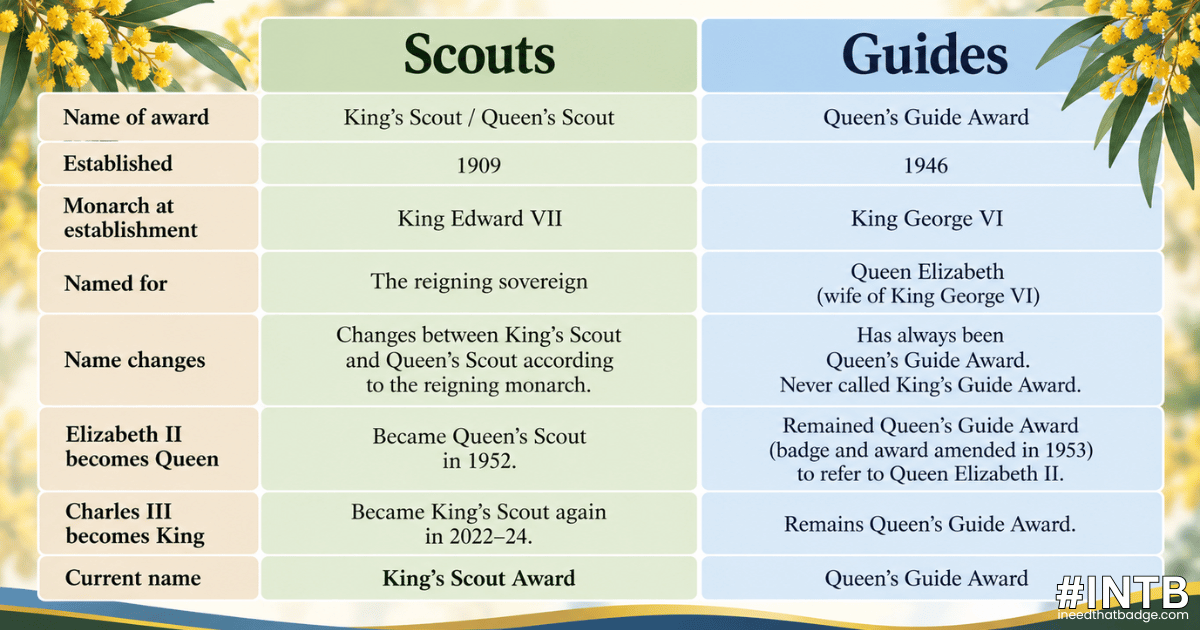
In contrast to Guiding, the highest award in the Scouting movement has historically changed between King’s Scout and Queen’s Scout according to the reigning monarch. Following the accession of King Charles III, the Queen’s Scout Award once again became the King’s Scout Award.
It began with King Edward VII in 1909
The award originated in 1909, only a couple of years after Baden-Powell's experimental camp on Brownsea Island.
The Scout award was deliberately established as an award connected to the reigning sovereign, and its name has consequently changed when the monarch changed from King to Queen or vice versa.
During a visit to the Royal Family at Balmoral Castle, Robert Baden-Powell discussed Scouting with King Edward VII. Baden-Powell suggested that boys who passed special tests demonstrating efficiency and practical skills could be recognised as “King’s Scouts”. Edward VII approved the idea.
Edward VII died in May 1910, very early in the award's life, and his successor King George V continued the royal sponsorship. Scouts Victoria records the earliest Victorian King’s Scout in 1911.
King’s Scout remained through three Kings
The award itself evolved through the years and became part of the older youth program when the Senior Scout section was established in 1946. The award title remained King’s Scout through the reigns of:
Edward VII → George V → Edward VIII → George VI
There was no need for a name change because each succeeding sovereign was also a King.
1952: King’s Scout becomes Queen’s Scout
King George VI died on 6 February 1952, and his daughter became Queen Elizabeth II.
Only a few months later, Scouts formally announced:
“With the gracious approval of Her Majesty the Queen, the King's Scout Badge will in future be known as the Queen's Scout Badge.”
That announcement was made in May 1952. The Queen also approved the continuation of the Royal Certificate, which includes a message from her.
What happened in Australia?
Australia followed the same tradition.
The Queen’s Scout Award subsequently became the peak award for Australian Venturer Scouts and remained so throughout Elizabeth II's exceptionally long reign. Generations of Australians knew it only as the Queen’s Scout Award simply because Elizabeth II was Queen for 70 years.
Queen’s Scout becomes King’s Scout again
When Queen Elizabeth II died on 8 September 2022 and Charles III became King, Scouts began the process of changing the award again.
UK Scouts unveiled its new King’s Scout Award in February 2023, explicitly explaining that the Queen’s Scout Award had carried that name for Elizabeth II's reign and would now become the King’s Scout Award.
Scouts Victoria records that Royal Patronage was granted by King Charles III in May 2024, after which the Australian peak award became the King’s Scout Award. A new Australian King's Scout certificate was designed in 2024.
There was consequently a transition period in which Queen’s Scout recipients were still being recognised while the new King's Scout Award was coming into operation. At a NSW Government House ceremony, the Governor specifically described the occasion as both a presentation of the new King's Scout Awards and, for the foreseeable future, the final presentation of Queen's Scout Awards to people who had completed the requirements earlier.
SCOUTS
KING'S SCOUT / QUEEN'S SCOUT
1909-1910
King Edward VII
King's Scout Badge
1910-1936
King George V
King's Scout Badge
1936
King Edward VIII
King's Scout Badge
1936-1952
King George VI
King's Scout Badge
1952-2022
Queen Elizabeth II
Queen’s Scout Badge (1952–2008)
Queen’s Scout Award (2008–2022)
2022+
King Charles III
King's Scout Award
King Charles III became monarch in September 2022. The Australian award was renamed the King’s Scout Award in May 2024.
Not All Royal Awards Follow the Same Tradition
There are other awards with a royal name too. Some are specifically associated with the reigning sovereign and therefore change between “King’s” and “Queen’s”. Others retain a royal name because it forms part of the history and identity of the award.
The Boys’ Brigade provides another example of an award that follows the reigning monarch. Its highest award was known as the Queen’s Badge during the reign of Queen Elizabeth II and was described by the organisation as the highest award a member could achieve. Following the accession of King Charles III, it became the King’s Badge. Like the King’s Scout Award, this demonstrates a tradition in which the royal title changes to reflect the reigning sovereign – quite different from the Queen’s Guide Award, which has retained its historic name.
The King’s Award for Voluntary Service, for example, was established by Queen Elizabeth II in 2002 to celebrate her Golden Jubilee. Originally known as the Queen’s Award for Voluntary Service, it was renamed the King’s Award for Voluntary Service following the accession of King Charles III.
A similar change occurred with the King’s Awards for Enterprise. These awards originated during the reign of Queen Elizabeth II in 1965 as the Queen’s Award to Industry and were later known as the Queen’s Awards for Enterprise. Following the accession of King Charles III, they became the King’s Awards for Enterprise.
The Duke of Edinburgh’s Award provides an example of a royal title becoming part of the permanent identity of an award. Established in 1956 with Prince Philip, Duke of Edinburgh, closely involved in its creation, the award retained the Duke of Edinburgh name following his death in 2021. The title represents the history and identity of the award rather than the identity of the reigning monarch.