

When most people think about dinosaurs, they often picture giant American predators like Tyrannosaurus rex or huge long-necked dinosaurs roaming across deserts in North America.
But Australia has its own fascinating dinosaur history with our own enormous plant-eaters and fast predators. We even have dinosaurs that lived in near-polar conditions.
Over the past few decades, Australian fossil discoveries have helped scientists better understand prehistoric life in the southern hemisphere and revealed that Australia was once home to a remarkable variety of dinosaurs.
A Very Different Australia
During the age of dinosaurs, Australia looked very different from today.
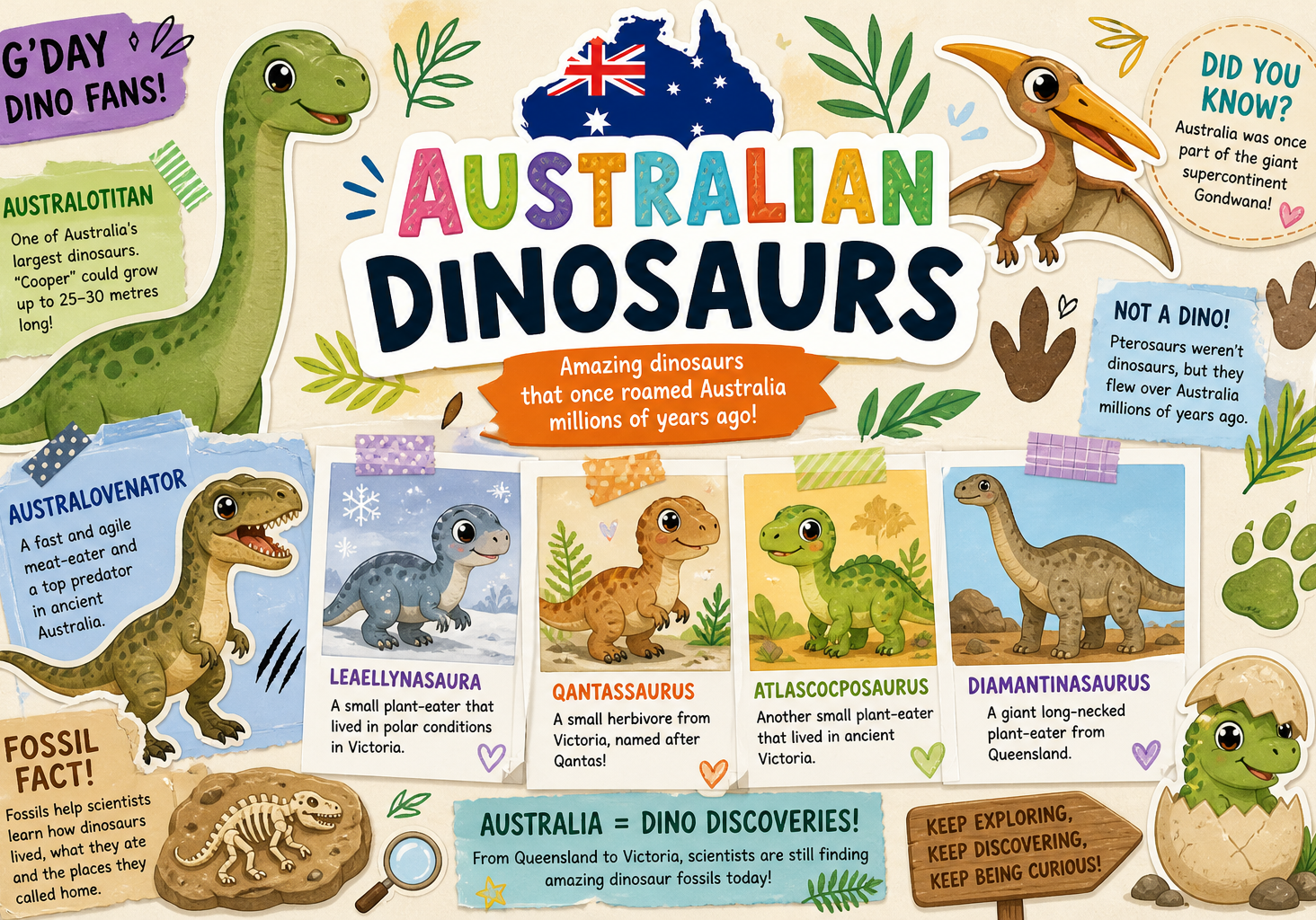
The continents were once joined together as part of a giant southern supercontinent called Gondwana, which included:
- Australia
- Antarctica
- South America
- Africa
- India
Australia remained connected to Antarctica long after Africa and India began to drift away. This “southern” connection allowed for the unique evolution of species that shared more in common with South American dinosaurs (like titanosaurs) than those in North America.
As the continents slowly drifted apart over millions of years, Australia’s dinosaurs evolved in relative isolation. Some dinosaurs that lived here developed unique features not seen elsewhere in the world.
Giant Australian Dinosaurs
Australia was home to several enormous long-necked dinosaurs known as sauropods.
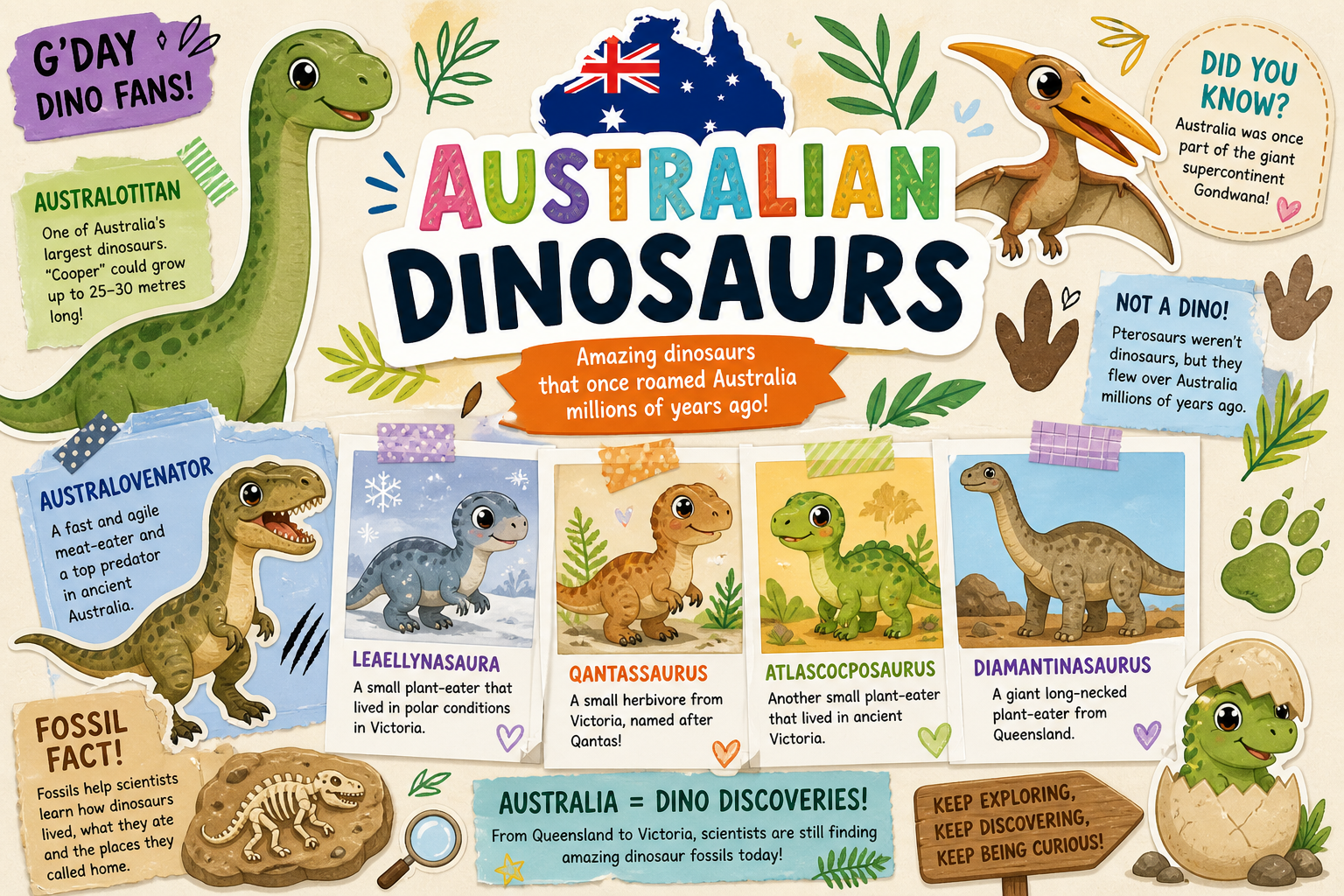
One of the most famous is Australotitan cooperensis, discovered in Queensland. Nicknamed “Cooper”, Australotitan is considered one of the largest dinosaurs ever found in Australia. Scientists estimate it may have reached around 25–30 metres in length, weighed many tonnes and walked on four massive legs
Other giant Australian sauropods include:
- Diamantinasaurus matildae
- Savannasaurus elliottorum
- Wintonotitan wattsi
Many of these fossils were discovered in Queensland’s famous Winton Formation, one of Australia’s richest dinosaur fossil areas.
Australia’s Dinosaur Predators
Australia also had meat-eating dinosaurs. One of the best known is Australovenator wintonensis, whose name means “southern hunter”.
Australovenator was fast and agile, equipped with sharp claws and teeth and likely an active predator
Unlike the enormous Tyrannosaurus rex, Australovenator was smaller and more lightly built, but it would still have been a formidable hunter.
Dinosaurs Near the South Pole
One of the most unusual things about Australian dinosaurs is that some lived in environments much closer to the South Pole than Australia is today. During the Early Cretaceous, southeastern Australia was located within the Antarctic Circle. While it wasn’t as cold as modern Antarctica, these dinosaurs had to survive months of total darkness and freezing temperatures.
Fossils discovered in Victoria, particularly around Dinosaur Cove, revealed the existence of small dinosaurs adapted to polar conditions.
These include:
- Leaellynasaura amicagraphica
- Qantassaurus intrepidus
- Atlascopcosaurus loadsi
Although the climate was warmer than modern Antarctica, these dinosaurs still experienced long winter darkness, cooler temperatures and seasonal changes. This challenged the old idea that dinosaurs only lived in hot tropical environments.
Fossils and Palaeontology
The study of dinosaurs is known as Palaeontology. Australian palaeontologists study:
- fossil bones
- footprints
- teeth
- eggs
- ancient plants
These discoveries help scientists reconstruct ancient ecosystems and understand how dinosaurs lived millions of years ago.
Fossil discoveries in Australia continue to grow, with new species still being identified today. Dinosaurs encourage curiosity about science, evolution, geology, and the history of Earth itself.
Australia’s Dinosaur Legacy
National Dinosaur Day occurs in Australia on May 7.
Although Australia may not have as many dinosaur fossils as some other countries, the discoveries made here are internationally important.
Australian fossils have helped scientists better understand:
- Gondwana
- dinosaur evolution in the southern hemisphere
- polar dinosaurs
- ancient Australian ecosystems
And with each new fossil discovery, scientists continue to uncover more about the prehistoric creatures that once walked across Australia millions of years ago.
It is an incredible reminder that beneath our modern cities, farms, and deserts lies the hidden story of an ancient world filled with dinosaurs.